Airport & Mall Cleaning Robots: Managing Large Spaces 24/7
Airports begin receiving passengers before sunrise and continue operating long after midnight. Shopping malls face a different rhythm, with changing footfall, food spills, trolley marks and constant movement across their floors. In both environments, cleaning is not a task that ends when one shift finishes. It has to keep pace with the building.
An airport cleaning robot can automate repeatable floor-cleaning tasks across suitable mapped areas, while a mall cleaning robot can help maintain large public floors throughout trading hours. The objective is not to eliminate cleaning teams. It is to organise repetitive floor care around the demands of a busy facility.
For facility managers, choosing the right system means looking beyond the machine itself. Floor type, footfall, cleaning windows, navigation, battery life and maintenance all affect how well automation fits into daily operations.
Why Large Facilities Need a Different Cleaning Approach
Cleaning a small office and maintaining an airport terminal are fundamentally different operational tasks. Large facilities have extensive floor areas, multiple zones and changing levels of activity. Some areas need frequent attention throughout the day, while others can be cleaned during quieter periods.
An airport cleaning robot can support scheduled floor maintenance in suitable terminal areas, corridors and other mapped spaces. A mall cleaning robot can perform repeat cleaning routes across concourses, atriums and open commercial floors.
The practical advantage is consistency. Instead of assigning every routine floor-cleaning round to manual operation, facility managers can automate defined routes and reserve staff time for spills, edges, corners, washrooms and tasks requiring closer attention.
The cleaning plan still needs to account for public movement, safety and the layout of the building. Automation works best when the task and operating conditions are clearly defined.
What Can a Mall Cleaning Robot Actually Do?
A mall cleaning robot is designed to perform specified floor-care tasks with limited manual steering. Depending on its configuration, it may sweep loose debris, scrub compatible hard floors or combine multiple cleaning functions.
In a shopping centre, suitable routes may include open concourses, wide corridors and selected common areas. Cleaning can be scheduled around footfall patterns, allowing the facility team to plan routine work without treating the entire building as one continuous cleaning zone.
An airport cleaning robot can serve a similar role in appropriate public circulation areas, provided the machine is suitable for the floor surface, pedestrian traffic and operating conditions.
Neither application is entirely hands-free. Teams still need to prepare the machine, manage consumables where applicable, check completed tasks and handle areas the robot cannot reach. The goal is to assign repeatable floor coverage to automation while keeping people responsible for detail work and exceptions.
Choosing the Right Cleaning Technology
Not every cleaning machine performs the same function. Before comparing models, identify what the facility needs to remove from its floors and which surfaces require attention.
A large-area floor scrubbing robot is designed for suitable hard floors that need routine scrubbing. Depending on the model, it may also sweep debris or manage water as part of its cleaning process. This makes it relevant to open commercial floors where repeat coverage is a priority.
A commercial autonomous vacuum robot serves a different purpose: it automates vacuuming on compatible surfaces. Its suitability depends on the floor material, debris type, navigation requirements and the area to be covered.
These categories should not be treated as interchangeable. A polished hard-floor concourse may need a different cleaning method from a carpeted airport waiting area. Food courts, entrances and service corridors can also have different requirements.
Start with the cleaning task, then shortlist equipment designed for it.
Navigation Matters as Much as Cleaning Power
A robot may have the right brushes and cleaning functions, but it still needs to navigate the facility reliably.
Autonomous cleaning systems use mapping and onboard sensors to understand their surroundings and follow designated routes. Depending on the technology, they can detect obstacles and adjust their movement rather than relying on continuous manual steering.
For an airport cleaning robot, this matters in areas where passengers, luggage trolleys and service equipment move through the same space. In a mall, the route may need to account for shoppers, promotional displays, furniture and changing store layouts.
During a site trial, observe how the machine handles people crossing its path, temporary obstructions and narrow passages. Check whether routes can be updated when the floor plan changes and what happens when a cleaning zone becomes inaccessible.
The right system should suit the actual building, not just perform well in an empty demonstration area.
Can Cleaning Robots Operate 24/7?
Around-the-clock facility operations do not mean a robot can run indefinitely without stopping. Battery life, charging, water capacity, maintenance and operating settings determine how much work it can complete within a given period.
A mall cleaning robot can be scheduled for suitable low-traffic periods or selected daytime routes, depending on the facility’s needs. An airport cleaning robot may follow a similar approach, with routes planned around passenger activity and operational restrictions.
Facility managers should calculate usable cleaning time rather than relying on battery life alone. Consider the area covered per hour, charging requirements, time spent on preparation and the interruptions likely to occur on the actual route.
Automatic return charging can reduce the need for manual intervention, but teams must still check the machine, maintain it and prepare it for its next cycle. Continuous facility cleanliness comes from a well-planned operating schedule, not uninterrupted robot movement.
How AIRA’s Cleaning Robots Fit Large Facilities
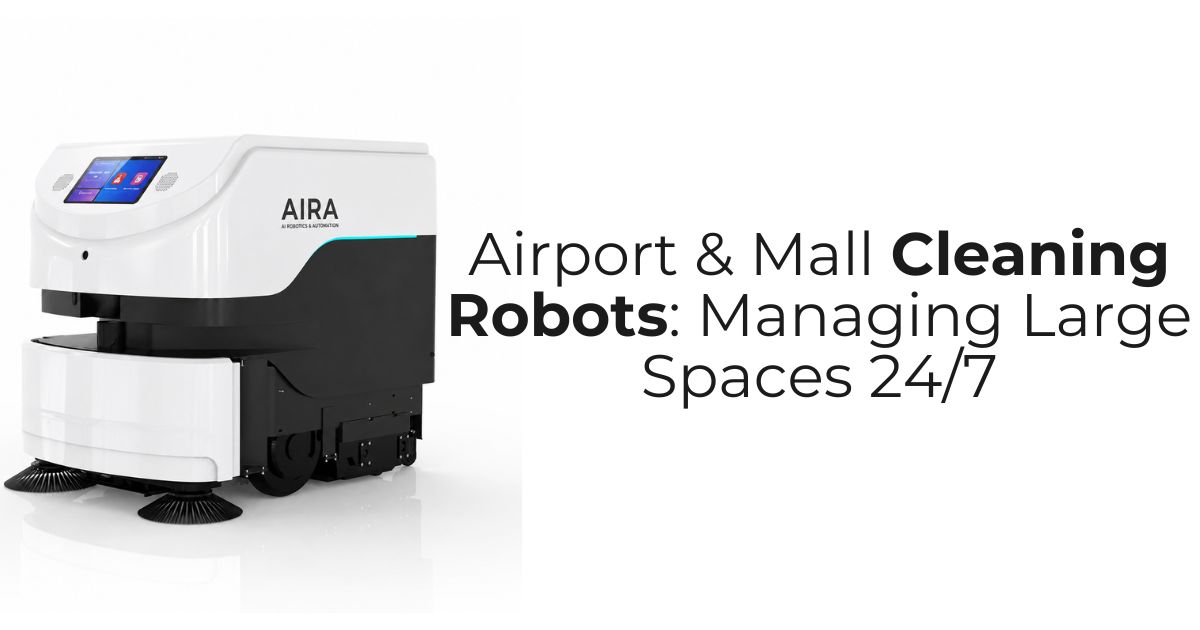
AIRA’s cleaning range includes machines designed for different floor-care requirements. Two models worth evaluating for large indoor environments are AIRA-C100 Clarity and AIRA-C300 Glide.
AIRA-C100 Clarity is designed for washing, vacuuming and dust-push cleaning across indoor floors. Its published specifications include a cleaning rate of 400–600 m² per hour, Laser SLAM navigation, automatic path planning, mobile and cloud monitoring and mapping capability of up to 10,000 m². Its stated operating time is 2–3.5 hours, with a 2-hour charging time.
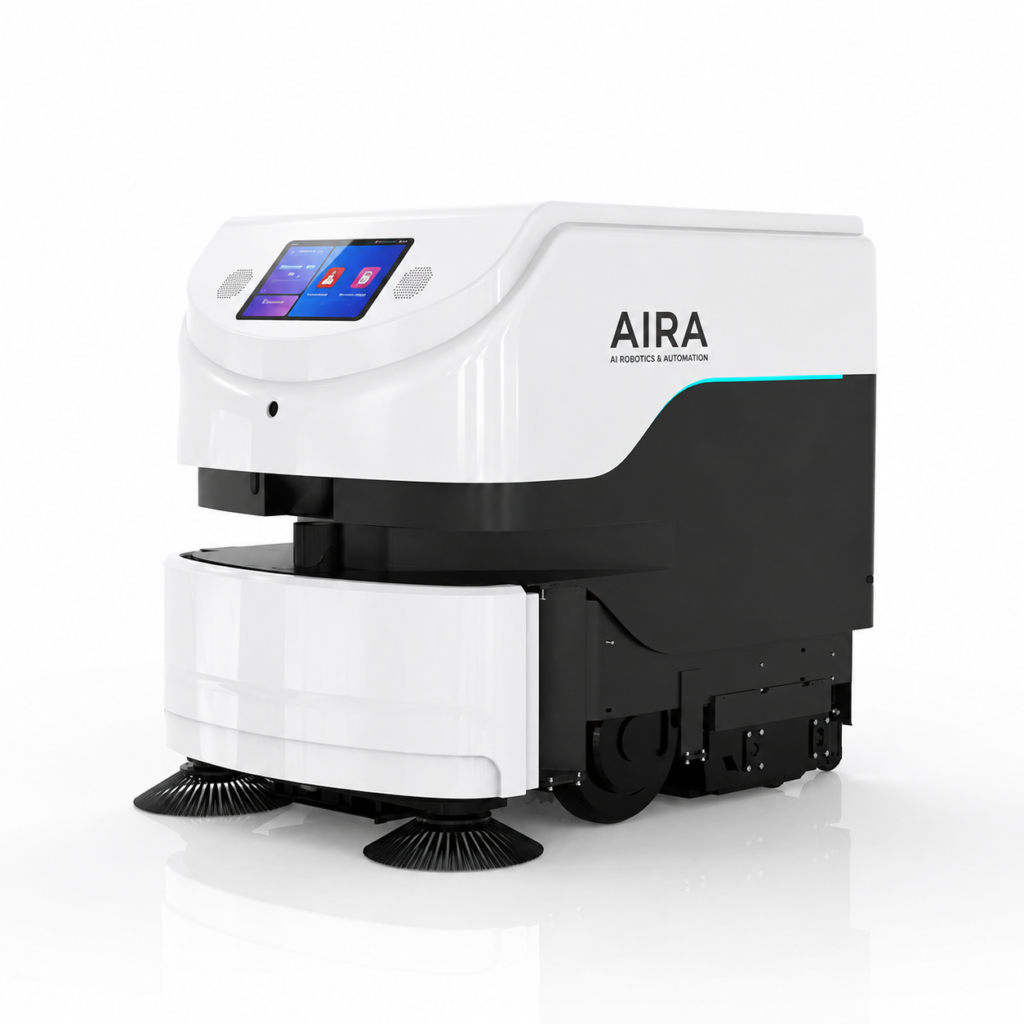
AIRA-C300 Glide is designed for autonomous sweeping and mopping across malls, warehouses and large commercial floors. It features dual-brush sweeping, laser-based navigation, autonomous path planning, automatic return charging and a 15-litre water tank. AIRA lists battery life of up to 11 hours in low gear.
The specifications describe different cleaning functions and operating profiles. Facility managers should compare them against their floor surfaces, required cleaning method, area coverage and daily schedule before selecting a suitable option.
What Facility Managers Should Check Before Buying
The right large-area floor scrubbing robot should be selected against the facility’s actual cleaning requirements, not just its advertised capacity.
Before purchase, assess:
- Floor compatibility: Confirm that the cleaning method suits the surface and its maintenance requirements.
- Coverage: Calculate the cleanable area per shift, accounting for obstacles and charging.
- Navigation: Test routes with realistic pedestrian movement and temporary obstructions.
- Operating schedule: Establish when the robot can work without disrupting passengers, shoppers or staff.
- Maintenance: Check brush, filter and other consumable requirements, along with service availability.
- Human oversight: Assign responsibility for preparation, monitoring, fault handling and areas needing manual cleaning.
For a commercial autonomous vacuum robot, add surface-specific checks and confirm that the system is suited to the debris it needs to collect.
A supervised site trial is especially useful in large facilities. Measure completed coverage, cleaning quality, interruptions and the assistance required from staff. These observations provide a more reliable basis for a buying decision than specifications alone.
Integrating Automation Into Daily Operations
Buying a robot is only one part of the process. The facility team also needs a workable deployment plan.
Begin by dividing the building into cleaning zones. Identify which areas require frequent maintenance, which can be cleaned outside peak hours and which are unsuitable for autonomous operation. Then define routes, charging locations, staff responsibilities and procedures for blocked paths or incomplete tasks.
An airport cleaning robot should be introduced with attention to passenger movement, access restrictions and coordination with airport operations. A mall cleaning robot needs a plan that accounts for trading hours, food-court activity, furniture movement and public safety.
Start with a defined area, review the results and adjust the schedule before expanding deployment. This gives the facility team time to understand the machine’s practical limits and establish responsibility for daily operation.
Plan Your Facility’s Cleaning Automation with AIRA
Large facilities need cleaning systems that fit their floor plans, operating hours and daily demands. AIRA brings autonomous robotics into defined operational tasks, helping businesses assess where automation can support their facility teams. Talk to us about your cleaning requirements and explore the right approach for your facility.