Indoor vs Outdoor Security Robots: Choosing the Right Patrol Solution
Security teams are responsible for more than watching cameras. They need to monitor entrances, identify unusual activity, inspect vulnerable areas and respond when something requires attention. In a large facility, carrying out these checks repeatedly across every shift can be difficult to coordinate.
An outdoor security robot can support patrols across suitable external areas, such as building perimeters, parking zones and industrial campuses. An indoor patrol robot, by comparison, is designed for controlled internal environments such as office corridors, hospital passages, warehouses and commercial buildings.
Both can help security teams cover routine patrol routes and identify potential concerns. The right choice depends on where the robot will operate, what it needs to detect and how its findings will reach the people responsible for security.
Indoor vs Outdoor Security Robots: What Is the Difference?
The primary difference lies in the environment each robot must handle.
An outdoor security robot needs to cope with external conditions, which may include uneven surfaces, changing light, dust, rain and temperature variations. Its navigation system must also account for open spaces, vehicle movement, perimeter boundaries and changes in the terrain.
An indoor patrol robot typically operates on mapped floors, corridors and designated internal routes. It must navigate around people, furniture, doors, equipment and temporary obstructions without disrupting normal activity.
These differences affect hardware, navigation, sensor performance, battery management and maintenance. A robot that works reliably on a smooth indoor floor may not be suitable for a sloping driveway or an exposed industrial yard.
Rather than selecting a robot based on its advertised features alone, facility managers should begin with the physical conditions and security requirements of the site.
Where Do Indoor and Outdoor Patrol Robots Fit Best?
The layout of a facility often determines which patrol solution makes practical sense.
An outdoor security robot may be considered for:
- Industrial campuses and manufacturing facilities
- Parking areas, access roads and building perimeters
- Logistics yards and warehouse exteriors
- Large institutional campuses and designated restricted zones
An indoor patrol robot may suit:
- Office buildings and corporate campuses
- Hospital corridors and selected internal areas
- Warehouses, distribution centres and production facilities
- Commercial buildings with mapped access routes
Some facilities need coverage across both environments. A manufacturing campus, for example, may have internal production areas, loading bays, external storage and perimeter fencing. One robot may not be suitable for every zone, particularly when the floor surfaces, weather exposure and detection requirements differ.
In these cases, security teams should assess whether separate systems or a combination of mobile robots and fixed cameras would provide more practical coverage.
Navigation, Terrain and Environmental Conditions
Navigation is central to autonomous patrol. The robot must follow its assigned route, recognise obstacles and operate safely when the environment changes.
An indoor patrol robot generally needs reliable mapping, obstacle detection and route planning. Corridors can become crowded, temporary equipment may block a passage, and furniture or storage arrangements can change. During evaluation, teams should check how the robot responds when its planned route is obstructed.
An outdoor security robot requires additional consideration of ground conditions and weather protection. Paved roads, ramps, gravel, drainage channels and changes in elevation can affect movement. Dust and moisture may also influence the suitability of the robot’s enclosure and sensors.
Ask manufacturers to clarify the robot’s environmental protection rating, permitted operating conditions, slope limits and surface compatibility. Do not assume that a machine described as autonomous is automatically suitable for every outdoor site.
A supervised trial on the actual premises can reveal practical limitations that may not be apparent in a product demonstration.
How Thermal Imaging Supports Security Patrols
Conventional cameras rely on visible light to capture images. Thermal cameras detect infrared radiation and represent differences in surface temperature as an image. This can help security teams identify people or unusual heat patterns in conditions where visible-light footage may offer limited information.
A thermal imaging security robot combines thermal sensing with mobile patrol capability. Depending on the system, it may support checks for human presence, unusual heat sources or temperature anomalies within its operating environment.
For an industrial facility, this capability may be useful when inspecting selected equipment areas or restricted zones. Around a perimeter, thermal imagery can help operators assess activity in poorly lit locations. However, thermal detection does not establish intent, and an unusual temperature reading is not proof of a security incident.
A thermal imaging security robot should therefore be evaluated for sensor resolution, detection range, environmental limitations and the quality of the alerts it generates. The thermal camera’s presence alone does not guarantee accurate identification in every situation.
What Does 24/7 Surveillance Really Mean?
Security risks do not follow a fixed shift schedule. Facilities may need patrol coverage overnight, during weekends or when particular areas have fewer people present.
A 24/7 surveillance robot can support a continuous security plan by carrying out scheduled patrols, capturing visual information and reporting defined events. The robot’s actual operating cycle, however, depends on battery capacity, charging time, route length, connectivity and maintenance requirements.
Continuous surveillance also does not mean every incident will be detected or resolved automatically. Cameras can have obstructed views, sensors can produce false alerts, and network interruptions can affect communication. Security teams need clear procedures for reviewing alerts and escalating genuine concerns.
When assessing a 24/7 surveillance robot, ask how it handles low battery levels, interrupted routes, connectivity loss and unexpected obstacles. Confirm how footage and event logs are accessed, how long data is retained and who is authorised to review it.
The objective is dependable coverage supported by a defined human response process, rather than assuming that autonomous patrol removes the need for supervision.
Choosing the Right Robot for Your Facility
The decision should be based on operational requirements, not on whether indoor or outdoor technology appears more advanced.
Use these questions to guide the selection:
- Operating environment: Will the robot travel indoors, outdoors or across both? Check floor surfaces, weather exposure, lighting and access restrictions.
- Patrol coverage: How large is the area, how long is each route and how frequently must it be inspected?
- Detection requirements: Does the site need visible-light cameras, thermal sensing, smoke or high-temperature alerts, or other specific capabilities?
- Navigation: Can the robot handle pedestrians, vehicles, changing layouts and temporary obstructions?
- Alert management: Where do alerts go, who verifies them and what happens when a threat is confirmed?
- Charging and maintenance: What are the operating and charging cycles, and who is responsible for daily checks?
- Data and access: Confirm recording policies, user permissions, storage arrangements and integration with existing security systems.
A thermal imaging security robot may be worth considering where low-light monitoring or temperature-based detection is part of the security requirement. A 24/7 surveillance robot may be relevant where recurring patrols and event reporting are priorities. These capabilities should be matched to a clearly defined operational need.
How AIRA-S100 Sentry Fits Into Security Patrols
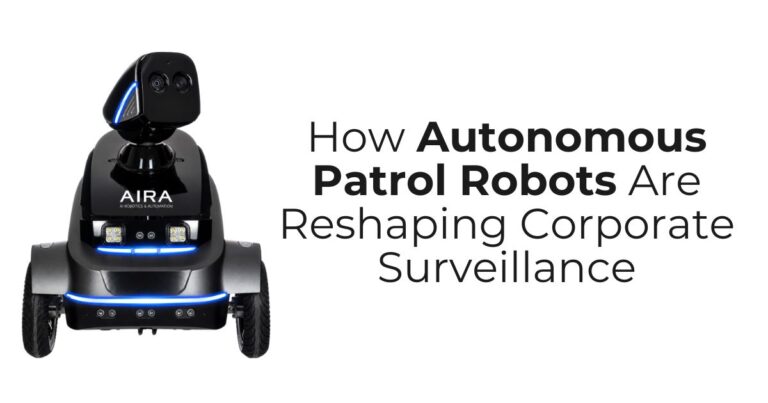
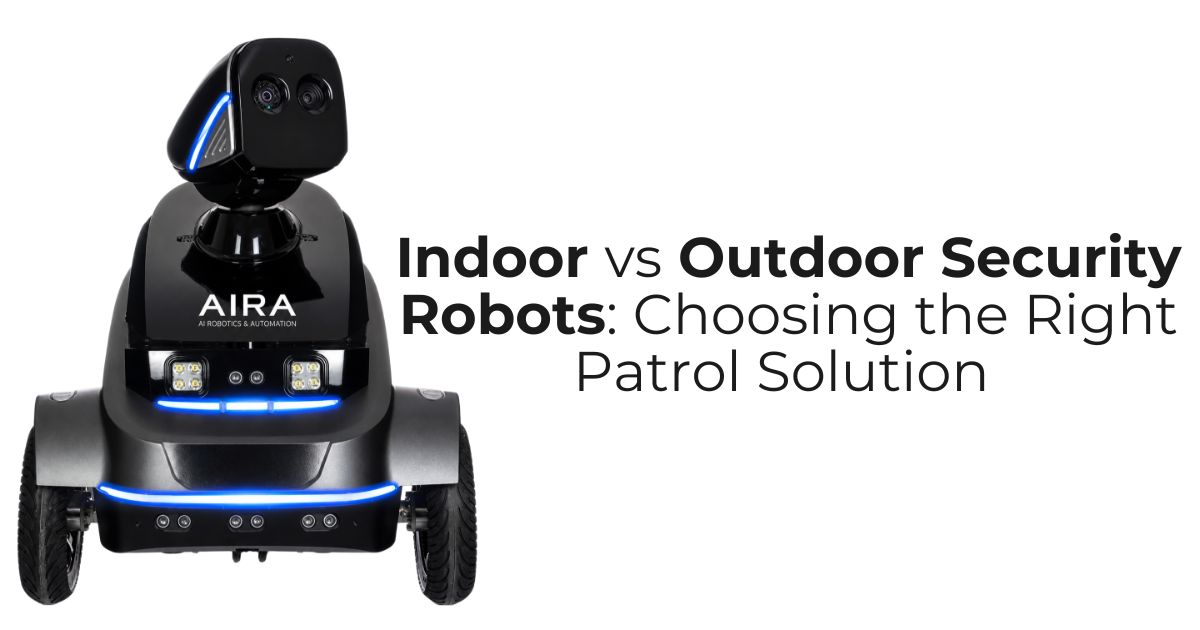
The AIRA-S100 Sentry is AIRA’s listed autonomous security patrol robot. Its specifications include AI visual recognition, thermal imaging, automatic patrol and recharge and a single-line LiDAR navigation system with a stated 40-metre radius and mapping capability of up to 20,000 m².
The camera configuration includes a 1080p visible-light camera, with thermal imaging and an optional 4K configuration. It has alerts relating to smoke, human presence, high temperatures and navigation abnormalities.
These functions may be relevant to facilities that need scheduled patrols and additional visibility across designated areas. For a facility manager, the next step is to assess the site layout, identify the patrol tasks and determine how the robot’s alerts would fit into existing security procedures.
Integrating a Patrol Robot With Your Security Team
A robot works best when its role is clearly defined within the wider security operation.
Start by mapping the patrol zones and deciding which routes should be automated. Establish charging points, access permissions, operating schedules and procedures for blocked paths or technical faults. Security personnel should also know how to receive alerts, verify events and contact the appropriate response team.
An indoor patrol robot may be introduced in a defined corridor or internal zone before its coverage is expanded. An outdoor security robot should be tested on representative external routes under the conditions it is expected to encounter.
Review the results using practical measures: completed patrols, missed routes, alert accuracy, downtime and the time required for human intervention. This gives decision-makers a clearer understanding of how the system performs under real operating conditions.
Autonomous patrol is most useful when it complements trained security personnel, established procedures and reliable incident response.
Find the Right Security Patrol Solution With AIRA
Security automation should begin with a clear understanding of the site, the risks that need attention and the responsibilities that remain with the security team.
AIRA helps businesses explore autonomous robotics for defined operational requirements. Discuss your facility’s layout, patrol priorities and monitoring needs with our team to assess whether the AIRA-S100 Sentry is a suitable option for your security operations.
FAQs:
1. What is the main difference between an indoor patrol robot and an outdoor security robot?
An indoor patrol robot is generally designed for mapped internal spaces, while an outdoor security robot must account for external surfaces and weather exposure. Navigation, enclosure protection and operating limits differ by model. The right choice depends on the facility’s layout and patrol requirements.
2. Can a 24/7 surveillance robot replace security guards?
A 24/7 surveillance robot can support scheduled patrols, capture footage and report defined events. It does not independently replace every responsibility involving judgement, communication, investigation or emergency response. Human security personnel remain essential for assessing alerts and taking appropriate action.
3. What does a thermal imaging security robot detect?
A thermal imaging security robot uses infrared sensing to identify temperature patterns that may indicate people or unusual heat sources. What it can detect depends on the sensor, software and operating conditions. Thermal alerts require context and verification before a security team treats them as an incident.
4. Can one patrol robot work both indoors and outdoors?
Some robots are designed for mixed environments, but this capability should be confirmed for the specific model. Surface conditions, weather protection, navigation and access arrangements can limit where a robot operates safely. A site assessment and supervised trial can establish whether one system is suitable.
5. What should businesses check before deploying security patrol robots?
Businesses should assess patrol coverage, navigation, sensor performance, environmental protection, battery cycles, data access and alert escalation procedures. They should also confirm who will maintain the robot and respond to incidents. Testing the system on actual patrol routes is an important part of selection.