Humanoid vs Task-Specific Robots: What’s Right for Your Business in 2026?
A robot that can perform multiple kinds of work sounds attractive. A robot built around one defined job can be easier to evaluate, deploy and manage. For a business considering robotics in 2026, that difference matters.
A humanoid service robot is being developed for broader physical tasks in environments designed around people. Task-specific robots take a different approach. They are engineered around a defined operational requirement, such as delivery, cleaning, security or material handling.
The choice is therefore less about which robot looks more advanced. It is about the work that needs to be automated, the environment in which it happens and the flexibility the operation actually requires.
What Is a Humanoid Service Robot?
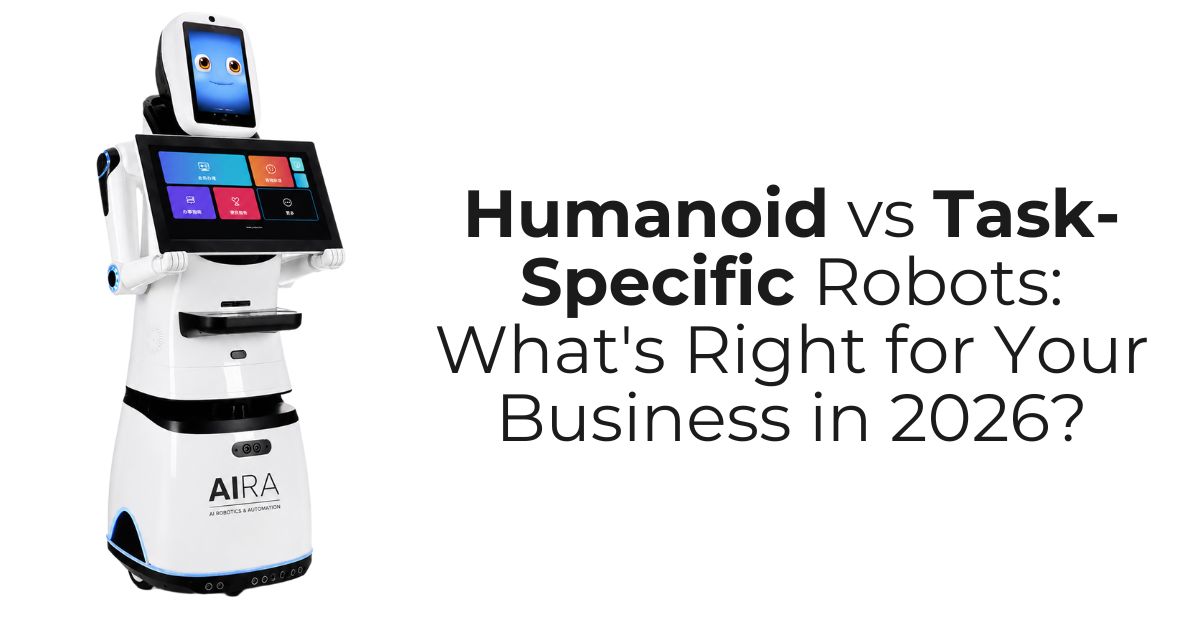
A humanoid service robot is designed with a human-like body and movement pattern, generally using two arms and a body structure suited to spaces created for people. The idea is to give a machine the physical form needed to interact with tools, workstations and routes designed for human workers.
That flexibility becomes relevant when one machine may need to perform different physical tasks. A warehouse, for example, could potentially use a humanoid for material-handling activities that vary across a working day.
The challenge is that broader capability brings a demanding engineering problem. A robot needs to perceive its surroundings, plan movement, manipulate objects and perform reliably as conditions change.
Enterprise humanoid adoption is still developing. Gartner’s 2026 forecast expects fewer than 20 companies to reach production stage for humanoid robots in manufacturing and supply chain by 2028, indicating that large-scale deployment remains an emerging area rather than an established operating model.
Where Task-Specific Robots Fit
Task-specific robots are built around a narrower operating requirement. That can be a strength rather than a limitation.
A delivery robot can focus on moving items between defined points. A cleaning robot can be designed around floor cleaning and autonomous navigation. An automated forklift can handle pallet movement inside a warehouse. A security robot can follow patrol routes and use visual or thermal sensing for defined detection tasks.
These are different types of service robots, but the principle is similar: the machine is designed around the job.
For a business, that makes the evaluation more concrete. Instead of asking whether a robot may eventually perform a broad range of activities, an operations team can ask whether the machine can perform the required task in the actual environment.
Humanoid vs Task-Specific Robots: The Practical Difference
The biggest distinction is the scope of the job.
A humanoid service robot aims for broader physical versatility. Its potential value increases when the business has tasks that vary and require a human-like physical interface.
Task-specific robots focus on repeatable work. Their value comes from matching the robot’s capabilities closely to a defined workflow.
This difference also affects deployment. A broad-purpose machine may require greater evaluation around manipulation, safety and task programming. A task-specific system can be assessed against a defined route, payload, floor type, access point or operating schedule.
Neither category should be selected from a product demonstration alone. The operating environment is part of the technology decision.
The Environment Often Decides the Choice
Consider a hotel. If the requirement is room-service delivery through mapped corridors, a dedicated delivery robot can be assessed against route length, payload, lift access, doors and guest interaction.
Now consider a warehouse where tasks change between picking, moving and handling objects designed for people. A humanoid may have a different potential role because its physical form is intended to work within human-oriented spaces.
Hospitals provide another example. A medicine delivery robot can be evaluated around secure access, internal routes, storage requirements and destination workflows. The requirement is specific, so the automation can be designed around that movement.
This is why types of service robots should be compared by application rather than appearance. Two robots may both operate autonomously, yet their business roles can be completely different.
How the Technology Works
Both categories can use AI, cameras, sensors and autonomous navigation, but those systems are configured for different purposes.
LiDAR uses laser measurements to help a robot understand the space around it. SLAM, or Simultaneous Localisation and Mapping, combines sensor information with software so the robot can build a map and determine its position within that map.
Computer vision adds another layer by helping a robot interpret visual information. Voice AI can support interaction where spoken communication is part of the application.
The technology stack does not automatically make one robot more suitable. What matters is how those capabilities perform within the required workflow.
A delivery robot may need route planning, obstacle avoidance and auto-return charging. A cleaning robot needs navigation and coverage planning. An AGV may need precise movement around production or warehouse routes.
What Should a Business Evaluate?
Start with the task.
What exactly needs to move, clean, inspect or deliver? How often does it happen? Is the route predictable? What payload is involved? Does the work happen around people? Does the robot need to use lifts, doors or access-control systems?
Then look at the operating environment. Floor layout, aisle width, obstacles, charging points and connectivity can affect deployment.
The next question is flexibility. If the task changes frequently, a broader robotic platform may deserve consideration. If the task is stable and repetitive, a task-specific system may be easier to define.
Support also matters. A business is not evaluating hardware in isolation. Deployment, mapping, integration, fleet monitoring, maintenance and post-installation support all affect how a robotic system operates over time.
Where AIRA Fits
AIRA focuses on autonomous service robots designed around defined real-world operating requirements. Its current catalogue covers delivery, cleaning and disinfection, reception, security and patrol and AGV and forklift applications.
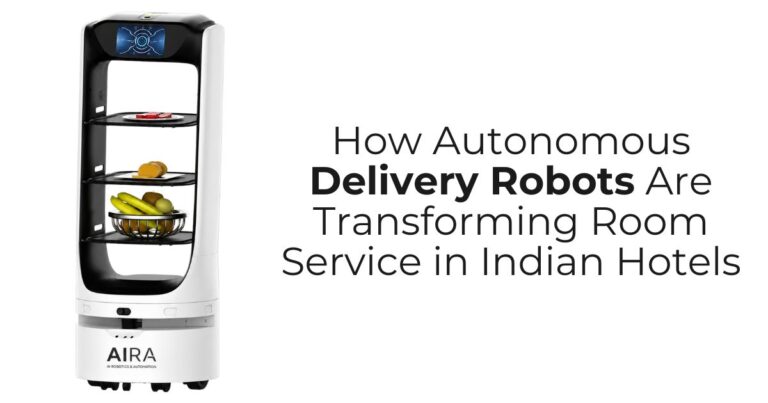
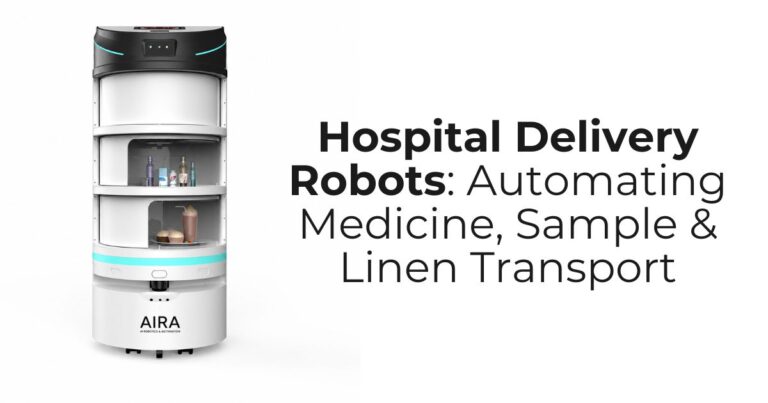
That portfolio illustrates the task-specific approach. AIRA-D200 Deligo is designed for precision delivery in restaurants, hospitals and hotels. AIRA-D300 Flash supports multi-floor delivery with autonomous scheduling and optional elevator and door control. AIRA-D400 Courier is designed for cross-floor hotel delivery, with elevator and access-control interaction. AIRA-D500 Nurse is built for secure delivery in hospitals and clinics.
The same principle extends across AIRA’s other categories. AIRA-C300 Glide is designed for autonomous sweeping and mopping, while AIRA-A400 handles automated forklift duties with a stated 1,400 kg maximum payload.
AIRA also provides a shared platform for autonomous mapping, fleet monitoring, usage analytics and maintenance support. Its technology includes LiDAR/SLAM navigation, computer vision and onboard AI capabilities, with custom integration options for systems such as access control and elevators.
For a business evaluating the best service robots 2026 has to offer, the first question is more useful when it starts with the operation: what exactly needs to be automated?
When a Humanoid Makes Sense
A humanoid service robot can become relevant when the business needs broader physical versatility and the target environment is already designed around human movement, tools and workstations.
The business case should still be specific. Identify the task, define the operating conditions and establish how the robot will be supervised, maintained and measured.
A humanoid form does not make a robot suitable for every task. In a high-volume operation with a clearly defined workflow, a dedicated machine may fit the requirement more directly.
When Task-Specific Robotics Makes Sense
Task-specific robots are particularly relevant when a business has repetitive movement or service tasks with defined operating conditions.
Hotels can assess delivery routes. Hospitals can assess internal medicine or consumable movement. Warehouses can examine pallet transport. Large facilities can assess cleaning or security patrols.
The key is to define the job before selecting the machine. That approach also makes it easier to evaluate integration, deployment requirements and ongoing support.
Choosing the Right Starting Point
The humanoid versus task-specific question becomes clearer when the business starts with the operation rather than the robot.
Map the repetitive work. Define the environment. Identify the required flexibility. Then assess the technology against those conditions.
For organisations exploring robotics in 2026, that process turns a broad technology discussion into a practical deployment conversation. AIRA‘s team can help businesses evaluate relevant use cases, robot categories and site requirements before moving towards deployment.
FAQs:
1. Are humanoid robots better than task-specific robots?
Neither category is automatically better for every business. A humanoid robot may suit an operation that requires broader physical flexibility across tasks designed around human environments. Task-specific robots are built around defined jobs such as delivery, cleaning, security or material handling. The right choice depends on the task, operating environment, required flexibility, payload and deployment requirements.
2. What is a humanoid service robot used for?
A humanoid service robot is designed to perform physical tasks in environments built around human movement, tools and workspaces. Its human-like form can be relevant when a business needs one robotic platform to handle different types of physical activities. The actual commercial use case depends on the robot’s capabilities, the operating environment and how the deployment is designed.
3. What are task-specific robots?
Task-specific robots are designed around a clearly defined operational function rather than a broad range of physical activities. Examples include robots for delivery, floor cleaning, security patrols, reception and warehouse material handling. Because the robot is built around a specific job, businesses can evaluate it against clear requirements such as route, payload, operating area, working hours and integration needs.
4. What types of service robots can businesses deploy?
The types of service robots available to businesses include delivery robots, cleaning and disinfection robots, reception robots, security and patrol robots, and material-handling systems such as AGVs and automated forklifts. Each category addresses a different operational requirement. The appropriate type depends on what the business needs to automate and the conditions in which the robot will operate.
5. Are humanoid robots ready for large-scale business deployment?
Humanoid robotics is still an emerging area of enterprise automation, with commercial deployments developing across industries. Businesses considering this category need to look beyond demonstrations and assess practical factors such as task reliability, safety, operating conditions, integration, maintenance and ongoing support. For a defined repetitive task, a task-specific robot may also provide a more direct route to deployment, depending on the use case.