Hospital Delivery Robots: Automating Medicine, Sample & Linen Transport
A hospital runs on movement. Medicines need to reach wards, samples need to reach laboratories, linen needs to move between departments and supplies have to travel across large campuses. These trips are necessary, repetitive and often spread across every shift.
That makes internal transport a practical area to examine when hospitals consider robotics. A hospital delivery robot can handle defined movement tasks across corridors and designated routes, allowing hospital teams to focus their time on work that requires clinical judgement, patient interaction or direct care.
The opportunity is less about replacing a person with a machine and more about giving routine transport a dedicated system. For hospital groups operating large facilities, this distinction matters. A robot needs to fit the building, the route, the payload and the workflow around it.
Why Internal Transport Deserves Attention
A medicine delivery robot can support a defined pharmacy-to-ward route. A separate route may connect the laboratory with sample collection points. Linen can follow another repeated path between storage, patient floors and service areas.
Each trip has a destination, a sequence and a timing requirement. Staff members often have to make these movements while also handling other responsibilities. When transport becomes frequent enough, the movement itself becomes an operational task worth examining.
A hospital delivery robot can be assigned to a defined route and programmed around the requirements of that environment. Depending on the model and deployment, autonomous navigation, mapping, route planning and automatic return charging can support recurring movement.
The practical question is not whether every hospital task should be automated. It is whether a recurring transport task has a clear route, predictable handling requirement and suitable operating environment.
What Can a Hospital Delivery Robot Move?
The answer depends on the robot, the payload and the hospital’s workflow. Internal hospital transport can cover a medicine delivery robot’s designated load, clinical samples, documents, meals, linen and other items.
For a medicine delivery robot, secure access becomes an important consideration. A robot used for hospital delivery can support controlled access workflows where the application and model allow it. AIRA’s D500 Nurse, for example, is designed for secure delivery in hospitals and clinics, with QR-verified access.
Samples require another level of care around handling and routing. The transport process needs to account for the destination, timing and type of material being moved. A robot does not remove those requirements; it provides an autonomous means of carrying out the defined movement.
Linen and general supplies present a different use case. Here, the focus can be on repeated movement between service areas and patient floors. The right system depends on payload, distance, floor access and the physical layout of the hospital.
How Autonomous Movement Fits Into a Hospital
An autonomous mobile robot for hospitals typically combines mapping, sensors and navigation software to understand and move through its operating environment. LiDAR-based navigation, camera systems and other sensors can help a robot identify its route and respond to obstacles, depending on the model.
Before deployment, the operating area needs to be mapped. Routes, access points, lift integration, doors and collection or delivery points may all form part of the deployment plan.
This is where medical logistics automation becomes an operational exercise rather than a standalone technology purchase. The hospital needs to define what is being moved, from where, to where, how often and under what access conditions.
For a hospital group, the same thinking can also be applied across multiple properties. A workflow that works in one facility may require adjustments in another because floor plans, lifts, corridors, access controls and delivery volumes differ.
The Case for Automating Repetitive Routes
A hospital delivery robot is most useful when the task itself is well defined. Repeated movement across a known route gives the robot a clear operating purpose.
Consider a pharmacy-to-ward route. If a medicine delivery robot is used repeatedly throughout the day, it can take on the transport leg while pharmacy and nursing teams remain focused on their core responsibilities. The exact workflow depends on the hospital’s processes and the robot’s capabilities.
The same principle applies to samples. A laboratory may receive material from multiple points within a facility. An autonomous route can provide a repeatable method for moving designated loads between approved locations.
Linen movement can also be assessed through this lens. If staff regularly spend time carrying linen across long internal routes, the transport activity can be separated from the work that requires their direct attention.
This is the operational value of medical logistics automation: creating a dedicated mechanism for recurring movement without assuming that every workflow should be handled in the same way.
What Hospitals Need to Assess Before Deployment
Choosing a hospital delivery robot starts with the property rather than the product catalogue.
The first consideration is the route. How far does the item travel? Are there multiple floors? Does the route cross public areas? Are lifts or automatic doors involved? These details affect the suitability of a deployment.
Payload is another factor. Medicines, samples and linen have different transport requirements. The storage format, weight and access method need to match the selected robot.
Then comes workflow. Who loads the robot? Who receives the item? What happens at the destination? Does the delivery require verification or controlled access? Clear answers make the deployment easier to define.
Technology integration may also matter. Hospital environments can involve access-control systems, lifts and other building infrastructure. Depending on the application, an autonomous mobile robot for hospitals may need integration with existing systems.
A practical assessment should therefore look at the complete movement cycle, from collection to delivery and return.
Where AIRA Fits Into Hospital Delivery
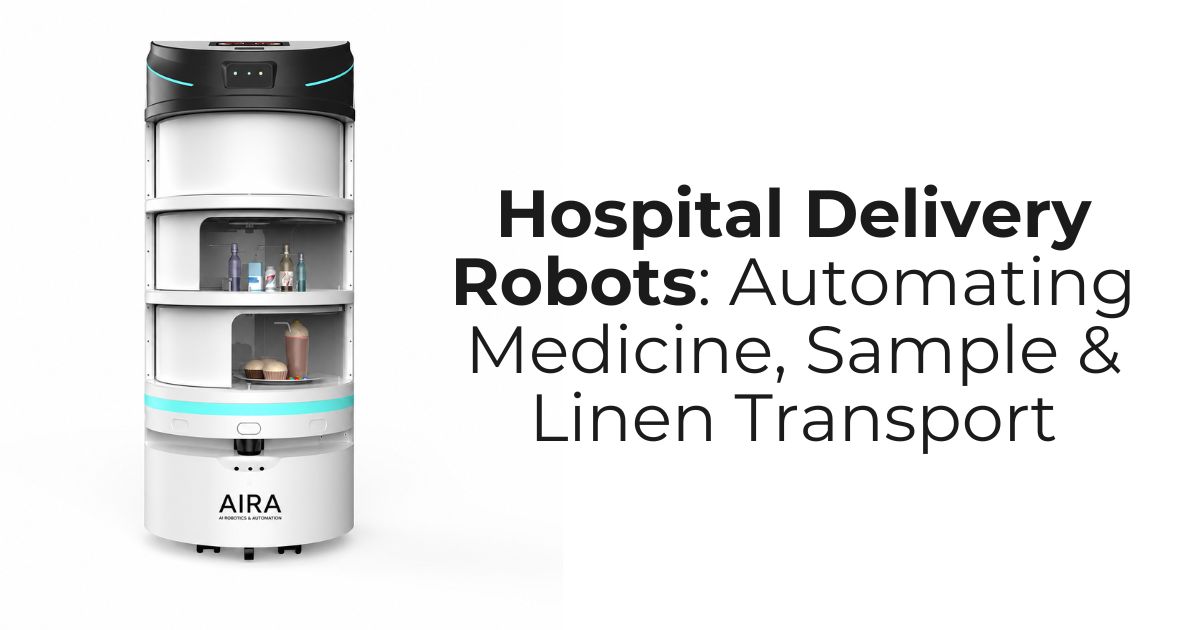
AIRA’s delivery range includes models designed for different environments and transport requirements. AIRA-D500 Nurse is positioned for secure hospital and clinic delivery, with three storage tiers, 10 kg per tray, QR-verified access and a stated 15–20 hour operating range.
Its role is defined by the delivery workflow rather than by a generic promise to automate the hospital. The application can be assessed around the route, payload, access requirements and operating environment across the hospital.
For hospitals considering medical logistics automation, this approach helps keep the discussion practical. The objective is to identify a transport task where autonomous movement has a clear place in the existing operation.
The same assessment can extend beyond medicine delivery. A hospital group may have separate transport requirements for samples, linen, meals or supplies. Each route can be evaluated on its own operating conditions before a robot is selected.
Automation Without Losing the Human Role
Healthcare has a different operating context from a warehouse or commercial facility. Patient care, clinical decisions and communication remain human responsibilities.
A hospital delivery robot can take responsibility for a defined movement task while staff continue to manage the work around it. That distinction is central to responsible deployment.
The value of automation is therefore found in task design. When repetitive transport is separated from clinical work, teams can spend their time where human judgement and interaction are required.
For hospital leaders, this also changes the conversation around robotics. Instead of asking whether a hospital needs robots, it is more useful to ask which recurring movements create a clear operational case for autonomous transport.
Start With the Movement, Not the Machine
Hospital transport becomes a stronger automation opportunity when the movement is frequent, defined and operationally measurable. A hospital delivery robot should be assessed against the actual property, route, payload and workflow.
For healthcare organisations evaluating robotics, the next step is straightforward: map the recurring internal transport tasks, identify where staff time is spent on movement, and assess which routes are suitable for autonomous operation.
AIRA can then help evaluate the relevant robot and deployment requirements around that specific use case. The right starting point is the recurring job that needs to move, not the robot itself.
FAQs:
1. Can a hospital delivery robot handle medicines?
It depends on the selected model, payload, access requirements and hospital workflow. Secure delivery applications may require controlled access and verification at the destination.
2. Is a medicine delivery robot suitable for every hospital?
No single model fits every property. Route length, floor access, payload, doors, lifts and delivery frequency should be assessed before selection.
3. What is medical logistics automation?
It refers to using technology to support the movement and handling of medical materials within a healthcare operation. Robotics can form part of this system for defined internal transport tasks.
4. What does an autonomous mobile robot for hospitals need to operate?
The requirements depend on the model and environment. Mapping, navigation, sensors, defined routes and suitable access conditions are among the factors that need to be assessed. An autonomous mobile robot for hospitals needs an operating area.
5. Can robots transport linen and samples too?
They can be considered for designated transport workflows when the robot’s payload, storage, route and handling requirements match the task.