How Autonomous Delivery Robots Are Transforming Room Service in Indian Hotels
Room service looks simple from the guest side: an order is placed, a meal is prepared and it reaches the room. Inside a large hotel, the process involves staff, lifts, corridors, service calls and repeated trips across the property. During busy periods, those trips become a significant operational task.
This is where a hotel delivery robot can fit into the workflow. Rather than treating robotics as a futuristic addition, hotels can use autonomous machines for defined delivery routes while staff focus on guest-facing work and decisions that require human judgement.
For hotels in India, the question is whether the task, property and operating model are suitable for automation. This article explains how autonomous delivery works, where it fits and what businesses should assess before deployment.
Why room service is a practical automation opportunity
Room service involves repeatable movement. A staff member collects an order, takes it to a room, waits for the handover, returns equipment or trays and moves to the next task.
The guest interaction requires people. The movement between locations is different: it follows defined paths and repeats throughout the day.
That makes internal delivery worth examining as an automation opportunity. A hotel delivery robot can handle defined movement while staff focus on service interactions and decisions that require human judgement.
For hotels, consistency matters too. Hospitality delivery automation can be assessed against the same workflow across properties, while each site is checked for its own layout and operating conditions.
What does an autonomous room service robot actually do?
An autonomous room service robot is designed to move items through an indoor environment without requiring a person to guide it throughout the trip.
A delivery may begin at a restaurant, kitchen or service area. The robot receives its route, travels through the mapped environment and reaches the destination. Depending on the model, the delivery is collected through a tray, compartment or access mechanism.
LiDAR, cameras and SLAM help the robot understand its surroundings, determine its position and plan movement. In plain terms, it needs to know where it is, where it needs to go and how to respond when people or obstacles enter its path.
For hotels, the building itself matters. Corridors, lifts, access-controlled areas and guest traffic all affect deployment.
Where a hotel delivery robot fits into hotel operations
The clearest use case is room-service delivery. A robot can carry food or approved items from a service area towards a guest room or collection point.
The application can extend beyond a single route. Hotels can also assess robots for internal movement of parcels, supplies and other routine items where the selected model supports that task. A property with multiple floors may require cross-floor movement, which changes the technology and infrastructure requirements.
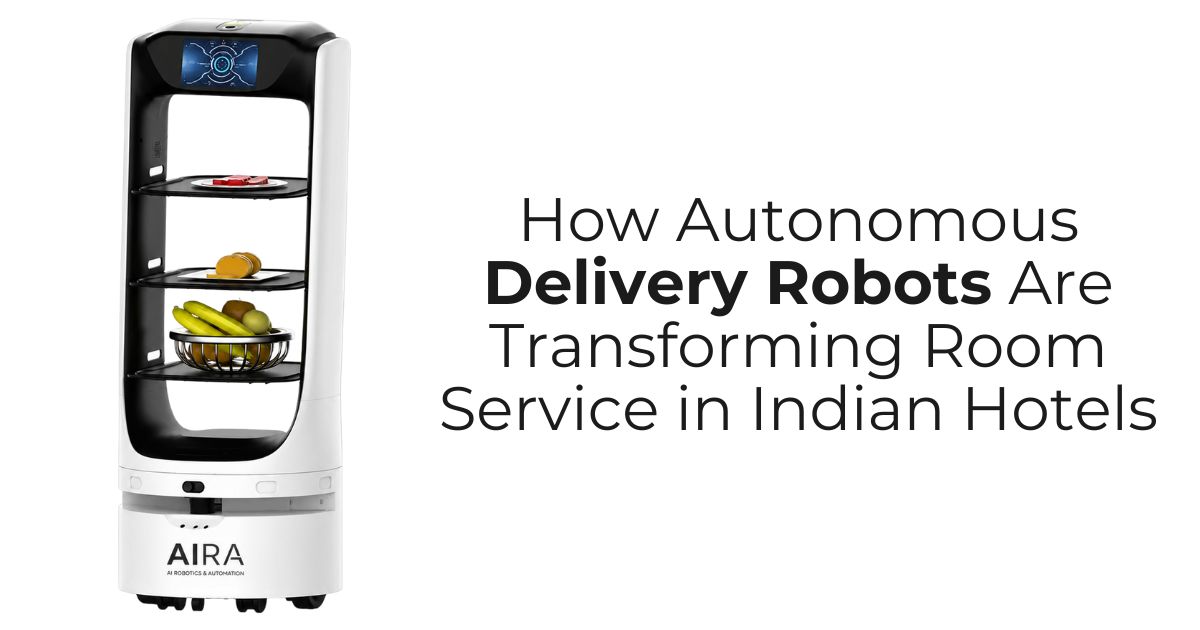
AIRA-D400 Courier is designed for room service and parcel delivery through access-controlled corridors. It supports elevator and access-control integration, has a 45-litre compartment and is specified for a 25–30 kg payload.
AIRA-D300 Flash is relevant where multi-floor movement is required. It combines autonomous scheduling, 3D obstacle avoidance and optional elevator or door control. Its four-layer design supports up to 15 kg per tray.
The right choice depends on the property. A hotel does not need the largest robot simply because it is available. The operating task should determine the specification.
What makes food delivery automation useful for hotels?
A food delivery robot for hotels can handle room-service movement while staff remain responsible for preparation, guest interaction and other service duties. In practice, a food delivery robot for hotels should be treated as part of the hotel’s service workflow.
The robot handles the route. The team handles the service. That keeps roles clear.
For hotels, a pilot can reveal how routes, lift access, delivery points, guest interaction and staff handoffs work in practice. Those findings can inform future deployments without assuming identical requirements across every property.
What should hotel chains consider before deployment?
A deployment begins with the site rather than the product brochure.
Identify the repetitive movement creating the need. How often does it occur? Between which locations? Does it involve one floor or multiple? Are lifts or access-controlled areas involved?
Then examine corridor width, floor layouts, guest traffic, furniture, doors and lift interfaces. An autonomous room service robot also needs a route that supports safe movement.
The workflow around the robot matters too. Who loads the delivery? Who receives it? Where does the robot wait? What happens if a route is blocked?
Technology integration may involve elevators, access-control systems or other operational software. The robot should fit into the existing process rather than create another process for staff to manage.
For chain brands, a standard site assessment can help compare properties before wider deployment.
How does an autonomous hotel delivery system work?
A typical autonomous delivery workflow has four stages: task assignment, route planning, movement and delivery.
The robot receives a task. Its navigation system uses the mapped environment to plan the route. Sensors help it respond to people and obstacles. At the destination, the delivery is collected through the available interface.
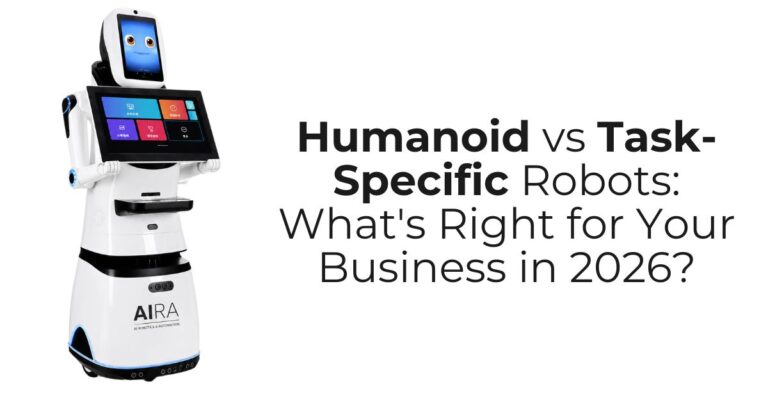
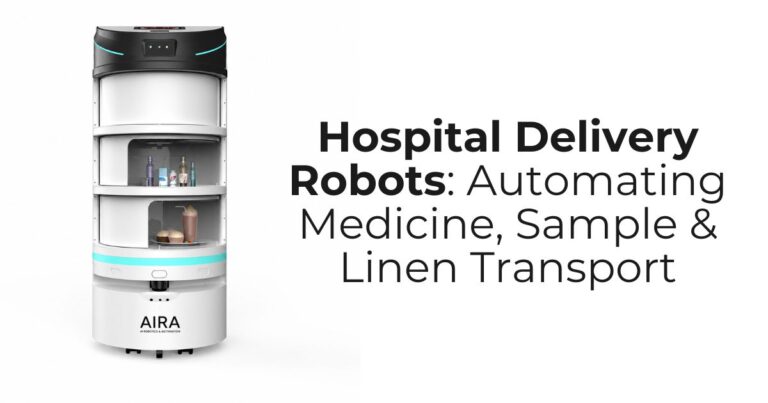
AIRA’s delivery range includes D100 Voyager, D200 Deligo, D300 Flash, D400 Courier and D500 Nurse. D100 is designed for multi-tray delivery. D200 supports hotels with autonomous path planning and plate/load reminders. D300 supports multi-floor delivery with optional elevator and door control. D400 is built around room service and parcel delivery. D500 is intended for secure hospital and clinic delivery.
For hotels, the relevant model depends on the delivery task, property and required route.
Beyond the robot: what support matters?
Buying a robot is one part of an automation decision.
A hotel needs to understand what happens after deployment: mapping, configuration, maintenance, monitoring, troubleshooting and operational support.
AIRA’s platform includes autonomous mapping, fleet monitoring, usage analytics, AMC and maintenance, and custom integration. For a chain, fleet visibility can become relevant when deployments expand across properties. Hospitality delivery automation then becomes a fleet management question as well.
The robot is the visible part. The support structure behind it is part of the business case.
What does this mean for Indian hotel chains?
India’s organised hospitality sector includes properties with different layouts, service models and technology adoption levels. A blanket automation strategy is therefore difficult.
A practical approach is to identify repeatable operational tasks and assess them property by property.
Room service can be a useful starting point because the workflow is easy to define: collect, move, deliver and return. An autonomous room service robot can fit that workflow when the route, environment and delivery requirements match its capabilities.
Where AIRA fits
AIRA approaches delivery robotics around defined operational requirements. Its hotel-relevant portfolio includes robots for multi-tray delivery, precision delivery, multi-floor movement and room-service or parcel delivery.
For a chain evaluating a hotel delivery robot, the conversation should begin with the property: routes, delivery volume, floor structure, access requirements and staff workflow.
AIRA can then assess which configuration fits that environment. Hospitality delivery automation should follow that site assessment. A food delivery robot for hotels needs a site-specific operational assessment first.
A discussion around the actual property can determine whether a hotel delivery robot is suitable, which model is relevant and what deployment requires.
Start with the operation, not the robot
Room service automation works best when it begins with a real operational problem. Hospitality delivery automation should start with a defined route, not a technology purchase. If a hotel chain is assessing repetitive internal delivery, the next step is to examine the routes, property layout, delivery requirements and systems involved.
AIRA’s delivery robots are built for different operating environments and delivery needs. A food delivery robot for hotels should be selected against the property’s actual route and payload requirements. A discussion around the actual property can determine whether a hotel delivery robot is suitable, which model is relevant and what deployment requires.
FAQs:
1. What is an autonomous delivery robot?
An autonomous delivery robot is an autonomous machine designed to move approved items through a hotel. Depending on its configuration, it can support room service, parcels or other internal deliveries.
2. Can an autonomous room service robot use hotel elevators?
AIRA D300 and D400 support elevator control. Integration depends on the hotel’s elevator system and deployment requirements.
3. Can robots work around hotel guests?
Autonomous delivery robots are designed for indoor operation around people and obstacles. Suitability depends on the hotel’s layout, traffic and deployment conditions.
4. What can a food delivery robot for hotels carry?
Tray capacity, payload and compartment design vary by model. For hotels, a food delivery robot for hotels should match the route.
5. Is hospitality delivery automation suitable for hotel chains?
It can be suitable when a chain has repeatable delivery tasks and properties that support autonomous operation. A site assessment should come first.
6. How should a hotel start evaluating robotics?
Start with one defined repetitive task. Map the route, understand the workflow, identify infrastructure requirements and compare suitable models.